
Mediation vs. Arbitration: Understanding the Key Differences in Alternative Dispute Resolution
Introduction
When parties seek to resolve disputes outside of traditional litigation, mediation and arbitration are two of the most commonly used forms of alternative dispute resolution (ADR). While both aim to avoid the time, expense, and adversarial nature of court proceedings, they differ significantly in structure, control, and outcomes. Understanding these differences allows individuals, attorneys, and organizations to choose the approach best suited to their needs and the nature of the conflict.
Mediation: A Collaborative, Party-Driven Process
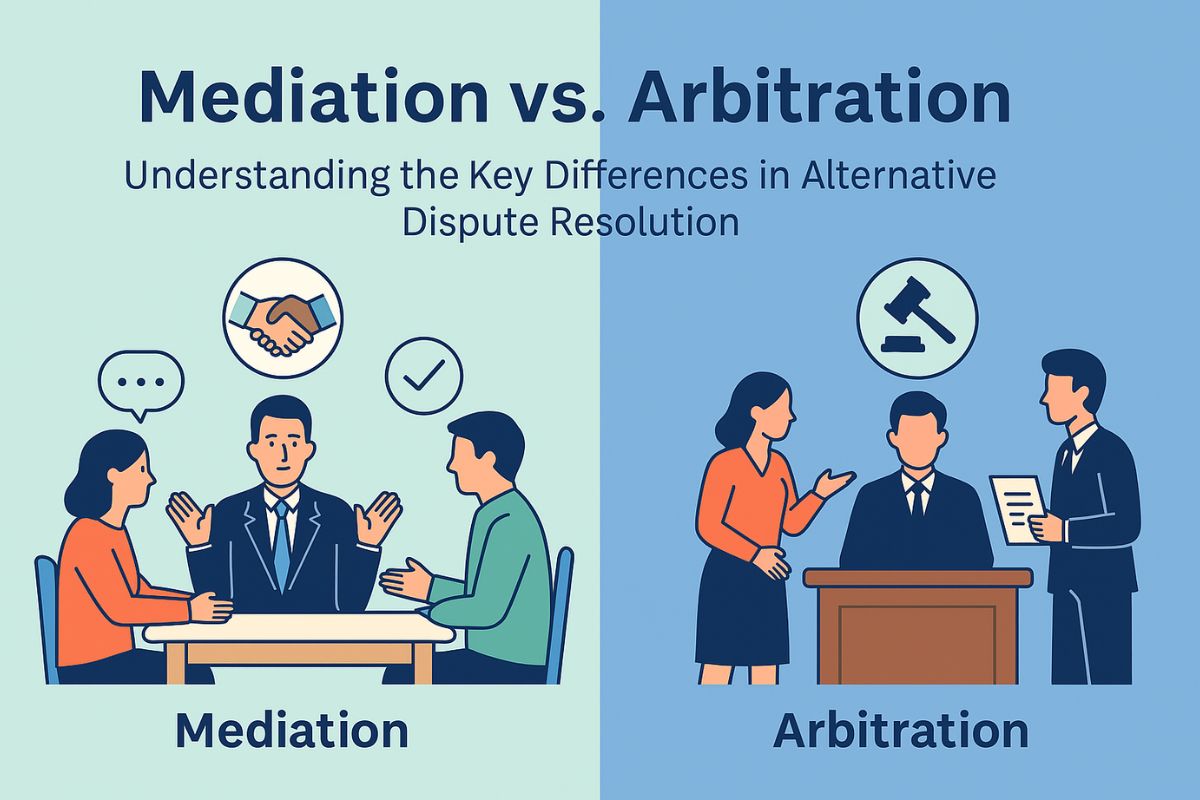
Mediation is a facilitated negotiation guided by a neutral third party, the mediator. As illustrated on the left side of the image, the mediator’s role is not to decide the case but to help the parties communicate, clarify issues, and explore mutually acceptable solutions.
Key Characteristics of Mediation
Voluntary and flexible: Parties retain full control over whether and how they reach an agreement.
Non-binding (unless agreement is reached): The mediator does not impose a decision.
Collaborative in nature: Focuses on communication, compromise, and shared understanding.
Confidential: Discussions are generally private and cannot be used later in court.
When Mediation Works Best
Mediation is particularly effective when:
Parties want to preserve a relationship (e.g., family, business partners)
There is room for compromise
Emotional or interpersonal dynamics are driving the conflict
Arbitration: A Structured, Decision-Based Process
In arbitration, a neutral arbitrator (or panel) hears evidence and arguments and makes a decision.
Key Characteristics of Arbitration
More formal than mediation: Follows a structured process similar to a trial
Binding or non-binding: Often results in a binding decision enforceable like a court judgment
Decision imposed by a third party: The arbitrator determines the outcome
Limited appeal rights: Particularly in binding arbitration
When Arbitration Works Best
Arbitration is appropriate when:
Parties want a final, enforceable decision without going to court
The dispute is more technical or legal in nature
Cooperation between parties is limited or unlikely
Core Differences at a Glance
Mediation Arbitration
Facilitated negotiation Decision-making process
Parties control outcome Arbitrator controls outcome
Informal and flexible More formal and structured
Focus on resolution and collaboration Focus on judgment and finality
Non-binding unless agreement reached Often binding
Conclusion
Mediation and arbitration serve different purposes within the broader landscape of dispute resolution. Mediation empowers parties to work collaboratively toward a mutually acceptable solution, often preserving relationships and reducing emotional and financial costs. Arbitration, by contrast, provides a more structured and definitive resolution when agreement is unlikely or a binding outcome is necessary.
Choosing between the two is not simply a procedural decision—it is a strategic one. Understanding the dynamics of the conflict, the goals of the parties, and the desired level of control can help determine which path leads to the most effective and sustainable resolution..
The Benefits of Mediation
Mediation offers a powerful alternative to traditional litigation by focusing on resolution rather than conflict. It is not just a different process—it produces different outcomes, often with greater efficiency, less emotional strain, and more durable agreements.
🌿 1. Greater Control Over the Outcome
Unlike court or arbitration, mediation allows the parties themselves to shape the resolution.
You are not handing your outcome to a judge
Agreements can be tailored to your specific needs
Creative solutions are possible beyond legal limitations
👉 This often leads to more practical and livable outcomes
⚖️ 2. Cost-Effective
Litigation is expensive. Mediation significantly reduces:
Attorney fees
Court costs
Time away from work
👉 Many disputes can be resolved in hours or a few sessions, rather than months or years
⏳ 3. Faster Resolution
Court timelines are slow and unpredictable.
Mediation:
Can be scheduled quickly
Moves at the pace of the parties
Often resolves disputes in a fraction of the time
👉 This reduces prolonged stress and uncertainty
🧠 4. Reduced Emotional Impact
Litigation is adversarial by design. Mediation is not.
Focuses on communication rather than confrontation
Reduces escalation and hostility
Creates space for understanding
👉 Especially important in family and ongoing relationships
👨👩👧 5. Preserves Relationships
Mediation is designed to protect, not destroy, relationships.
Encourages collaboration
Reduces long-term resentment
Supports healthier future interactions
👉 Critical in family law, co-parenting, and business partnerships
🔒 6. Confidential Process
Unlike court proceedings, mediation is typically private.
Discussions are not part of the public record
Sensitive issues can be addressed openly
Protects personal and professional reputations
🎯 7. Higher Compliance with Agreements
When parties create their own agreements, they are more likely to:
Follow through voluntarily
Feel ownership over the outcome
Avoid future disputes
👉 Results are often more durable and sustainable
🧩 8. Focus on Solutions, Not Just Legal Positions
Courts decide based on law. Mediation allows consideration of:
Personal priorities
Emotional realities
Practical needs
👉 It shifts the conversation from “winning” to resolving
🧠 9. Flexibility in Process
Mediation can be adapted to fit the situation:
In-person or virtual
Joint or separate sessions
Structured or more conversational
🌿 Conclusion
Mediation is not about avoiding conflict—it is about approaching it differently.
It provides a framework where individuals can:
Be heard
Maintain control
Reach meaningful, lasting resolutions