
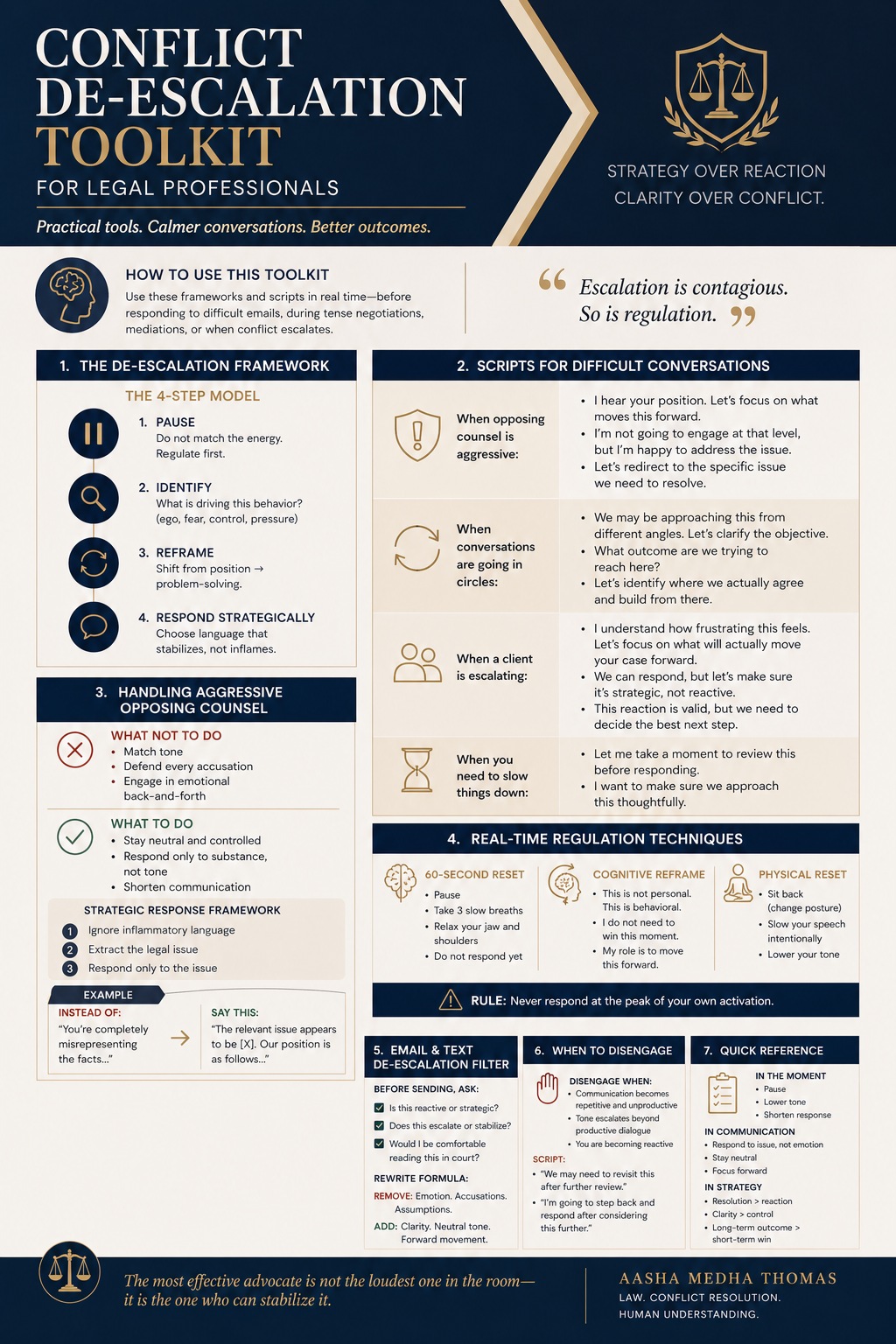
Conflict De-Escalation Toolkit for Legal Professionals
A practical, plug-and-play system for managing conflict in real time—without compromising advocacy.
Conflict in legal settings is not just procedural—it is behavioral, emotional, and often reactive.
This toolkit provides structured, usable tools to stabilize interactions, reduce escalation, and move matters forward strategically.
________________________________________
🧠 HOW TO USE THIS TOOLKIT
Use this in real time:
● Before responding to difficult emails
● During tense negotiations or mediations
● When opposing counsel escalates
● When your client is reactive
________________________________________
🔹 SECTION 1: DE-ESCALATION FRAMEWORK
🧭 The 4-Step De-Escalation Model
1. PAUSE
Do not match the energy. Regulate first.
2. IDENTIFY
What is driving this behavior? (ego, fear, control, pressure)
3. REFRAME
Shift from position → problem-solving
4. RESPOND STRATEGICALLY
Choose language that stabilizes, not inflames
________________________________________
⚠️ Key Principle
Escalation is contagious. So is regulation.
________________________________________
🔹 SECTION 2: SCRIPTS FOR DIFFICULT CONVERSATIONS
🗣️ When opposing counsel is aggressive:
● “I hear your position. Let’s focus on what moves this forward.”
● “I’m not going to engage at that level, but I’m happy to address the issue.”
● “Let’s redirect to the specific issue we need to resolve.”
________________________________________
🗣️ When conversations are going in circles:
● “We may be approaching this from different angles. Let’s clarify the objective.”
● “What outcome are we trying to reach here?”
● “Let’s identify where we actually agree and build from there.”
________________________________________
🗣️ When a client is escalating:
● “I understand how frustrating this feels. Let’s focus on what will actually move your case forward.”
● “We can respond, but let’s make sure it’s strategic, not reactive.”
● “This reaction is valid, but we need to decide the best next step.”
________________________________________
🗣️ When you need to slow things down:
● “Let me take a moment to review this before responding.”
● “I want to make sure we approach this thoughtfully.”
________________________________________
🔹 SECTION 3: HANDLING AGGRESSIVE OPPOSING COUNSEL
⚖️ What NOT to do:
● Match tone
● Defend every accusation
● Engage in emotional back-and-forth
________________________________________
🧠 What TO do:
● Stay neutral and controlled
● Respond only to substance, not tone
● Shorten communication
________________________________________
🔄 Strategic Response Framework:
1. Ignore inflammatory language
2. Extract the legal issue
3. Respond only to the issue
________________________________________
✍️ Example:
Instead of:
“You’re completely misrepresenting the facts…”
Say:
“The relevant issue appears to be [X]. Our position is as follows…”
________________________________________
🔹 SECTION 4: REAL-TIME REGULATION TECHNIQUES
🧠 60-Second Reset (Use Immediately)
● Pause
● Take 3 slow breaths
● Relax your jaw and shoulders
● Do not respond yet
________________________________________
🧠 Cognitive Reframe
● “This is not personal. This is behavioral.”
● “I do not need to win this moment.”
● “My role is to move this forward.”
________________________________________
🧠 Physical Reset
● Sit back (change posture)
● Slow your speech intentionally
● Lower your tone
________________________________________
⚠️ Rule:
Never respond at the peak of your own activation.
________________________________________
🔹 SECTION 5: EMAIL & TEXT DE-ESCALATION FILTER
🔴 Before Sending:
● Is this reactive or strategic?
● Does this escalate or stabilize?
● Would I be comfortable reading this in court?
________________________________________
✅ Rewrite Formula:
Remove:
● Emotion
● Accusations
● Assumptions
Add:
● Clarity
● Neutral tone
● Forward movement
________________________________________
✍️ Example Transformation:
Before:
“Your client is being completely unreasonable.”
After:
“We appear to have a difference in position. Our proposal is as follows…”
________________________________________
🔹 SECTION 6: WHEN TO DISENGAGE
🚨 Disengage when:
● Communication becomes repetitive and unproductive
● Tone escalates beyond productive dialogue
● You are becoming reactive
________________________________________
🗣️ Script:
● “We may need to revisit this after further review.”
● “I’m going to step back and respond after considering this further.”
________________________________________
🔹 SECTION 7: QUICK REFERENCE
(PRINT THIS PAGE)
🔹 In the Moment:
● Pause
● Lower tone
● Shorten response
________________________________________
🔹 In Communication:
● Respond to issue, not emotion
● Stay neutral
● Focus forward
________________________________________
🔹 In Strategy:
● Resolution > reaction
● Clarity > control
● Long-term outcome > short-term win
________________________________________
🌿 CLOSING PERSPECTIVE
De-escalation is not weakness.
It is strategic control under pressure.
________________________________________
🧠 Signature Line
The most effective advocate is not the loudest one in the room — it is the one who can stabilize it.
A tailored emotional intelligence assessment for attorneys
Instructions:
Rate each statement from 1–5
1 = Strongly Disagree
5 = Strongly Agree
________________________________________
🔹 SECTION 1: SELF-REGULATION (Emotional Control Under Pressure)
1. I remain calm when opposing counsel becomes aggressive.
2. I am aware of my emotional triggers during conflict.
3. I can pause before reacting, even under pressure.
4. I regulate my tone and body language intentionally.
5. I recover quickly after emotionally charged interactions.
________________________________________
🔹 SECTION 2: CONFLICT STYLE (Approach to Conflict)
6. I adapt my conflict approach based on the personalities involved.
7. I recognize when a situation requires collaboration vs. firmness.
8. I avoid escalating conflict unnecessarily.
9. I can identify when a client is contributing to the conflict dynamic.
10. I shift strategy when a current approach is not working.
________________________________________
🔹 SECTION 3: COMMUNICATION PATTERNS
11. I actively listen without preparing my response while others speak.
12. I can reframe difficult conversations to reduce defensiveness.
13. I tailor my communication style to the audience (judge, client, OC).
14. I recognize when communication breakdowns are emotional, not logical.
15. I ask questions that move conversations forward rather than entrench positions.
________________________________________
🔹 SECTION 4: DECISION-MAKING UNDER PRESSURE
16. I make decisions based on strategy, not emotional reactivity.
17. I can distinguish between urgency and importance.
18. I maintain clarity even when stakes and emotions are high.
19. I recognize when my judgment may be influenced by stress or bias.
20. I can guide clients toward sound decisions despite emotional resistance.
________________________________________
📊 SCORING
● Add each section separately (5–25 per section)
● Total score range: 20–100
Score Interpretation (per section):
● 21–25: High EQ competency
● 16–20: Functional but inconsistent
● 11–15: Needs development
● 5–10: Likely impacting outcomes
________________________________________
📘 PERSONALIZED REPORT TEMPLATE
(This is what I deliver after they complete it)
________________________________________
🧠 EQ Profile Snapshot
Overall Score: ___ / 100
● Self-Regulation: ___ / 25
● Conflict Style: ___ / 25
● Communication: ___ / 25
● Decision-Making: ___ / 25
________________________________________
✨ Key Strengths
(Auto-fill based on highest section scores)
Example:
● Strong emotional regulation under pressure
● Ability to adapt conflict strategy across personalities
● Clear, audience-aware communication
________________________________________
⚠️ Potential Blind Spots
(Based on lowest scoring sections)
Example:
● Reactivity under high-stakes stress
● Over-reliance on positional advocacy
● Missing emotional drivers in client behavior
________________________________________
🔄 Behavior Shifts (Actionable)
If Self-Regulation is low:
● Implement a pause protocol before responding in conflict
● Track emotional triggers in high-conflict cases
If Conflict Style is low:
● Identify whether conflict is ego-driven, fear-driven, or strategic
● Shift from control to influence strategies
If Communication is low:
● Use reframing language (“What I’m hearing is…”)
● Ask forward-moving questions instead of reactive responses
If Decision-Making is low:
● Separate legal analysis from emotional pressure
● Use structured decision frameworks with clients
________________________________________
🎯 Practice Impact
● Improved negotiation outcomes
● Reduced escalation in high-conflict cases
● Stronger client trust and compliance
● More efficient case resolution
________________________________________
🧠 Closing Line
Emotional intelligence is not a soft skill in law — it is a strategic advantage.